
AMS vs CRM vs ERP: Which System Does Your Association Actually Need?
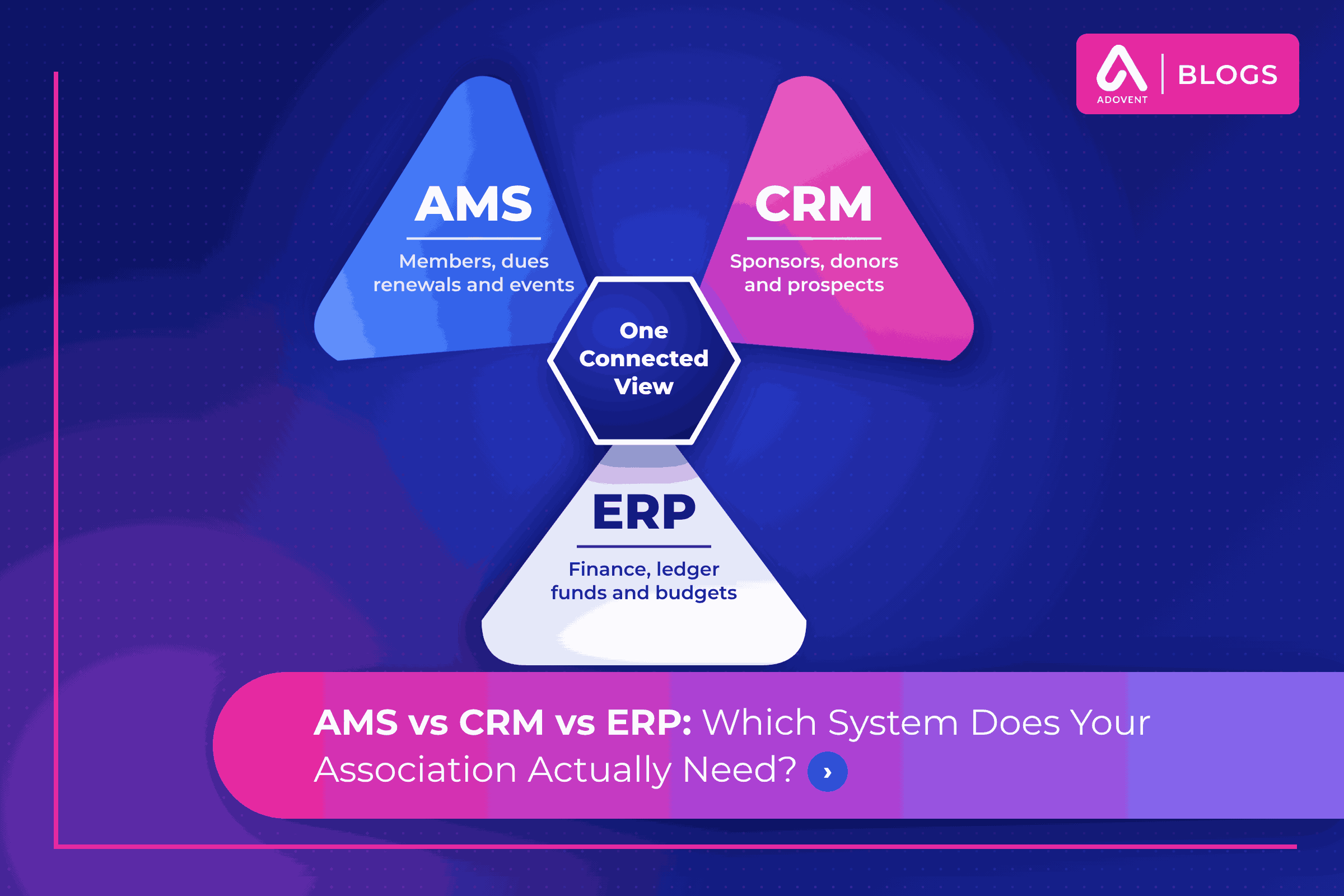
AMS vs CRM is the question many association leaders ask when member data stops matching, but the honest answer adds a third system: the ERP that runs your finance and accounting.
Quick answer: An AMS runs membership, dues and events. A CRM tracks wider relationships, such as sponsors, donors and prospects. An ERP keeps the books. Most associations need the jobs of all three, but not always three separate products, and almost always better connections between them.
Below, we explain each system in plain words, which jobs belong where, where associations get stuck, whether you need all three, and a five-step way to decide what to fix, connect or replace.
What is the difference between an AMS, a CRM and an ERP?
An AMS (association management system) is the software associations use to manage members, renewals and events. It knows who belongs, at what level, and whether their dues are paid.
A CRM is the database where you keep track of the people and organizations you work with. For an association, that often means relationships membership does not cover: exhibitors, sponsors, foundation donors, legislators or companies you hope will join.
An ERP is the software that runs finance and accounting. It holds the general ledger (the master record of every dollar in and out), invoices, bills and budgets. SylogistMission ERP, for example, is built on Microsoft Dynamics 365 Business Central and covers fund accounting, grants and budgeting.
The three overlap. Each one stores names and addresses, and each one touches money. That overlap is exactly where the trouble starts.
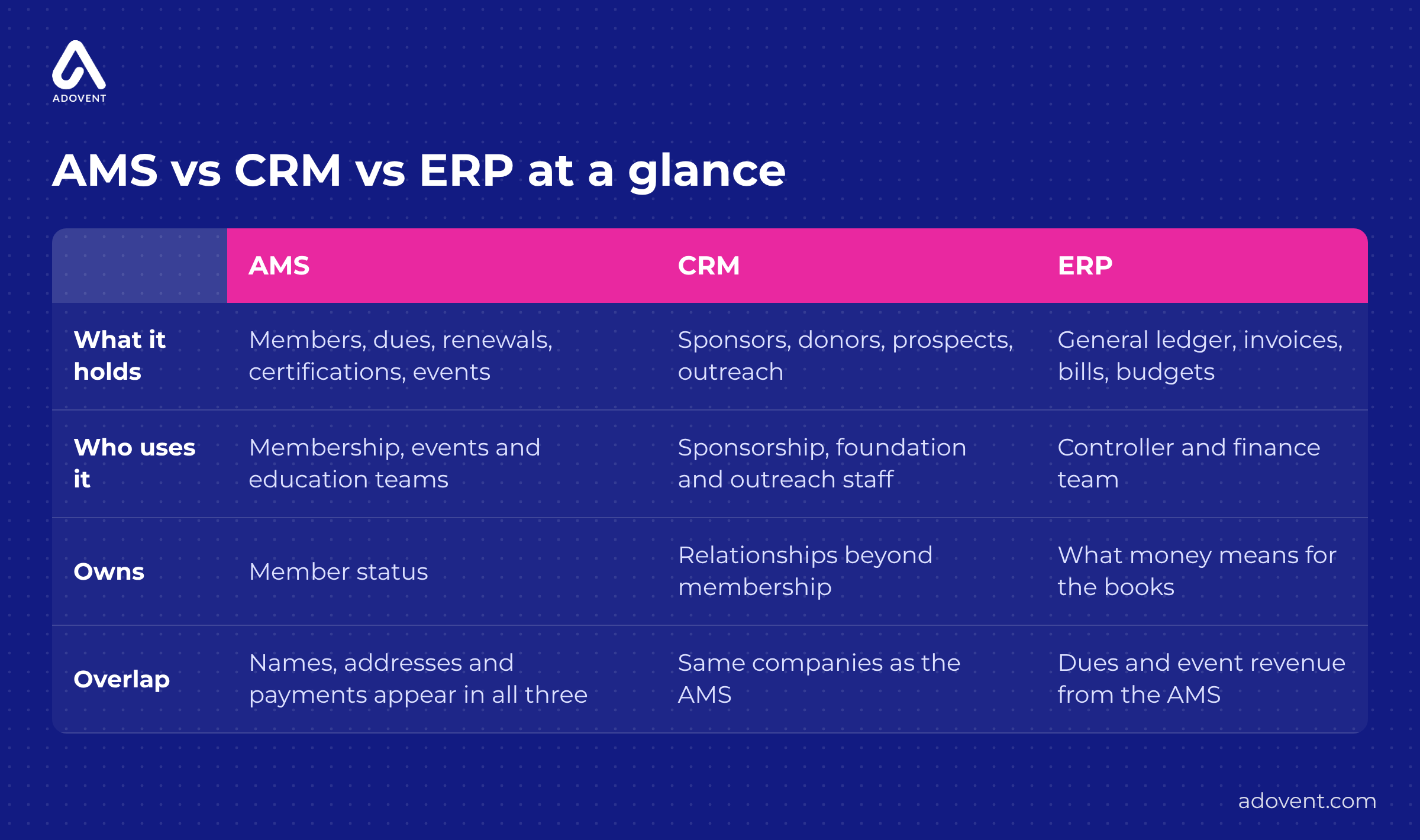
What each system holds, who uses it, and where the three overlap.
AMS vs CRM vs ERP: which jobs belong in each system?
1. Member status belongs in the AMS, and only there
A dentist passes her board certification in March and moves from associate to full member. The credentialing coordinator updates her own spreadsheet. The AMS still says associate. In June, the governance team pulls the voting roster for the board election, and she is left off. One status, kept in two places, cost a member her vote.
Fix: Name the AMS as the only place where membership status changes. Every other list reads from it.
2. Education and webinars should report back to the AMS
The education director runs a monthly webinar series in a separate meeting tool. Attendance stays there. At budget time, the CEO asks which members actually use education, and nobody can answer without matching two exports by hand. Members who attend often are also members who renew. That signal is lost.
What to do: Connect attendance to the member record with an integration (an automatic link that passes information from one system to another), or at least import it monthly with a member ID.
3. Sponsors, donors and prospects often need a CRM
A hospital system sponsors your annual meeting. Its chief nursing officer also gave $5,000 to your scholarship foundation, recorded in a donor spreadsheet. The sponsorship manager calls to renew the sponsorship without knowing about the gift. The relationship is bigger than any one team can see.
What to do: List the relationships that are not memberships. If they involve real money or long cultivation, track them in a CRM that shares contacts with the AMS.
4. Money lands in the ERP, not in the AMS
A member pays 2027 dues in November 2026. The AMS records a payment. The controller, however, has to treat it as deferred revenue (money received for a year that has not started yet). Today she rebuilds a dues summary from AMS exports every month and keys it into the ledger.
Fix: Let the AMS send a daily summary of dues and refunds to the ERP. The AMS stays the record of who paid. The ERP decides what it means for the books.
Where do associations get stuck when the three do not talk?
5. The same member company exists three times
A large employer pays a group membership. In the AMS it is “Lakeview Health System.” The CRM has “Lakeview Health.” The ERP bills “LHS Inc.” at an address from 2019. The renewal invoice goes to the old address, and the group lapses for six weeks before anyone notices.
Fix: Give every person and company one ID number and carry it across all three systems. Merge duplicates before you connect anything.
6. The board asks one question and gets three answers
A board member asks what the annual meeting brought in. Events reports $640,000 in registrations. The sponsorship manager adds $210,000 from the CRM. The controller reports $795,000 after refunds and processing fees. Everyone is right, and the board trusts none of it.
Fix: Agree on one written definition of event revenue first. Then build one Power BI report (Microsoft’s reporting tool) that reads from all three systems. One reliable view starts below the dashboard.
7. Staff become the integration
Every Friday, the membership coordinator copies new members from the AMS into the email tool, then into the CRM. It takes most of the afternoon. When she is on vacation, new members miss their welcome email for two weeks.
Fix: Write down every copy-and-paste task and who does it. Each line is a candidate for an automatic link.
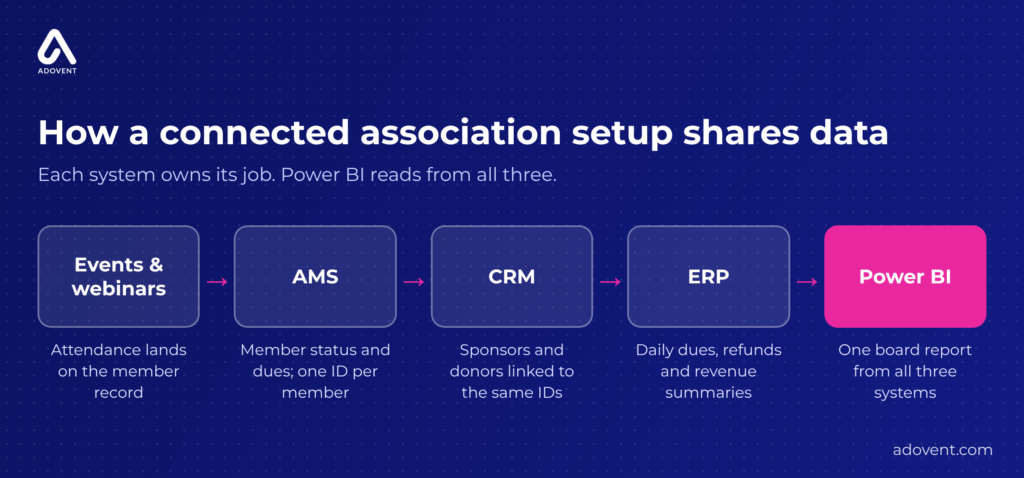
A connected setup: each system owns its job, and Power BI reads from all three.
Do you need all three, or one connected setup?
8. A small association may not need a separate CRM
A state association with one membership type, no foundation and a handful of sponsors can usually manage those relationships inside the AMS contact records. A separate CRM would add a third login and another place for data to drift.
What to do: Count the relationships outside membership. If a short list covers them, keep them in the AMS and connect it to finance first.
9. A shared foundation matters more than the number of systems
A national society with a foundation, an exhibit program and advocacy work usually needs all three jobs done well. On Microsoft, a Dynamics-based AMS and Dynamics 365 CRM can share the same underlying database, called Dataverse, while SylogistMission ERP runs on Business Central. Power BI can read from Dataverse and from Business Central. Fewer hand-offs means fewer places to disagree.
What to do: Judge your setup by how cleanly the systems share data, not by how many products are on the invoice.
How do you decide what your association needs next?
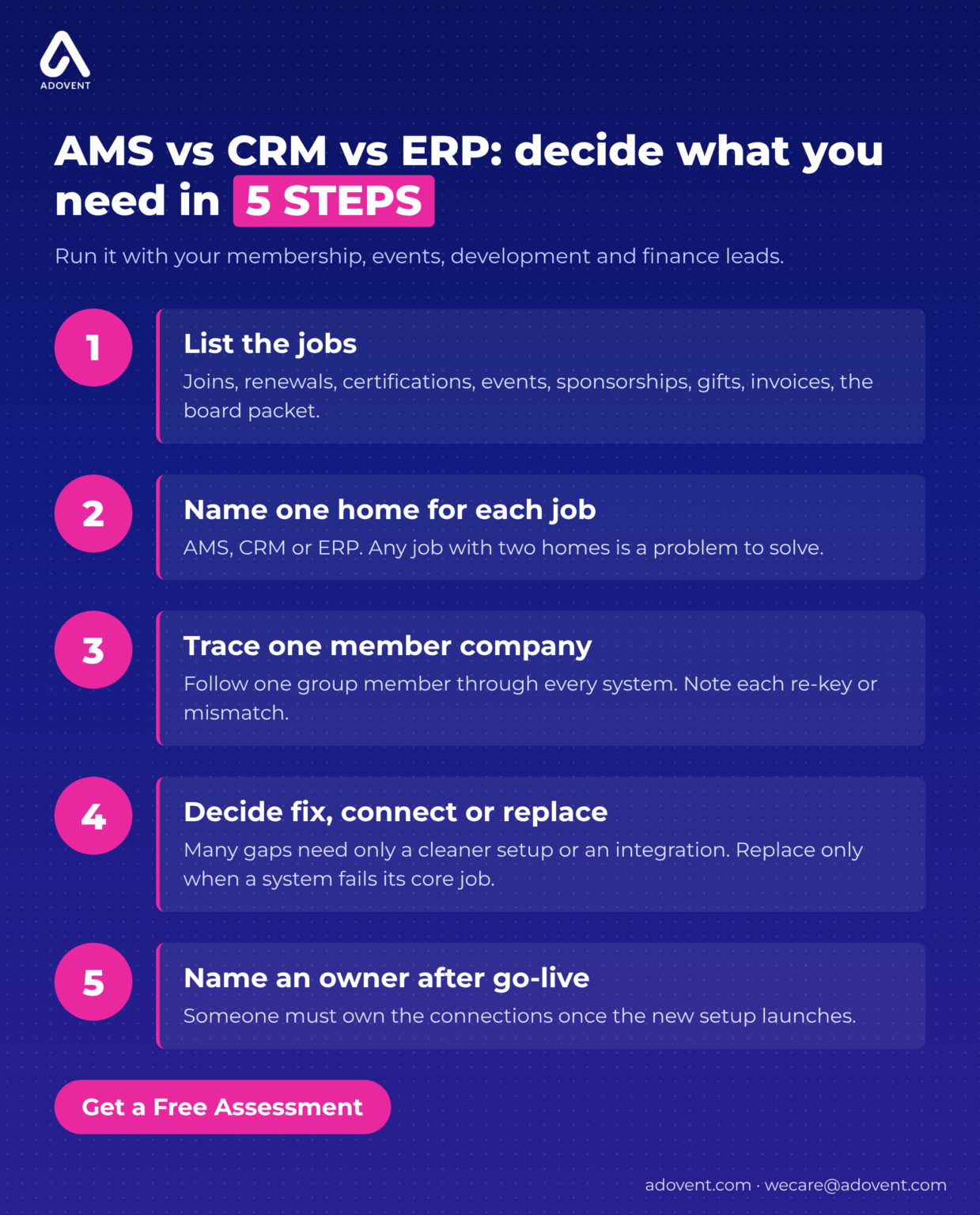
Run these five steps with your membership, events, development and finance leads. None of them needs new software.
- List the jobs. Write down every recurring task: joins, renewals, certifications, events, sponsorships, gifts, invoices, the board packet.
- Name one home for each job. Assign each task to the AMS, the CRM or the ERP. Any job with two homes is a problem to solve.
- Trace one member company. Follow a single group member through every system and note each re-key, export or mismatch.
- Decide fix, connect or replace. Many gaps need only a cleaner setup or an integration. Replace a system only when it cannot do its core job.
- Name an owner for after go-live. Go-live is the day a new setup launches. Someone must own the connections after that.
A nonprofit technology audit covers steps 2 to 4 in depth, and works the same way for associations.
Where Adovent fits
Adovent is a Sylogist partner and a Microsoft partner focused on nonprofits and associations. We do not start by assuming you need new software. We trace how members, money and events move through your systems, assess the data and connections, fix or connect what we can, and replace only when it makes sense. Then we stay to support and improve the setup. Learn more about our AMS, ERP and reporting work for associations.
FAQs
Is an AMS just a CRM for associations?
Not quite. Both store contacts, but an AMS adds membership rules: member types, dues, renewals, certifications and event pricing. A CRM is built around relationships and outreach, so it suits sponsors, donors and prospects better.
Can an AMS replace an ERP?
Usually not. An AMS can take payments and issue invoices, but it is not designed to be your general ledger, pay the bills or handle deferred revenue. Connect the AMS to your ERP instead of asking it to do the accountant’s job.
Do we need a separate CRM if our AMS has contact records?
Often not. If your outside relationships are few and simple, AMS contact records may be enough. A CRM earns its place when you run a foundation, a large sponsorship program or long-term outreach to prospective members.
Should we replace our AMS if the three systems do not talk?
Usually not first. Many “the AMS is broken” problems turn out to be missing connections, duplicate records or unclear ownership. Fix those, and then decide whether the AMS itself falls short.
Conclusion
AMS vs CRM is the wrong debate. Your association needs the jobs of all three systems done well.
Give every job one home.
Connect the systems before you replace any of them.
Then build the board report on top.
Leave a Reply